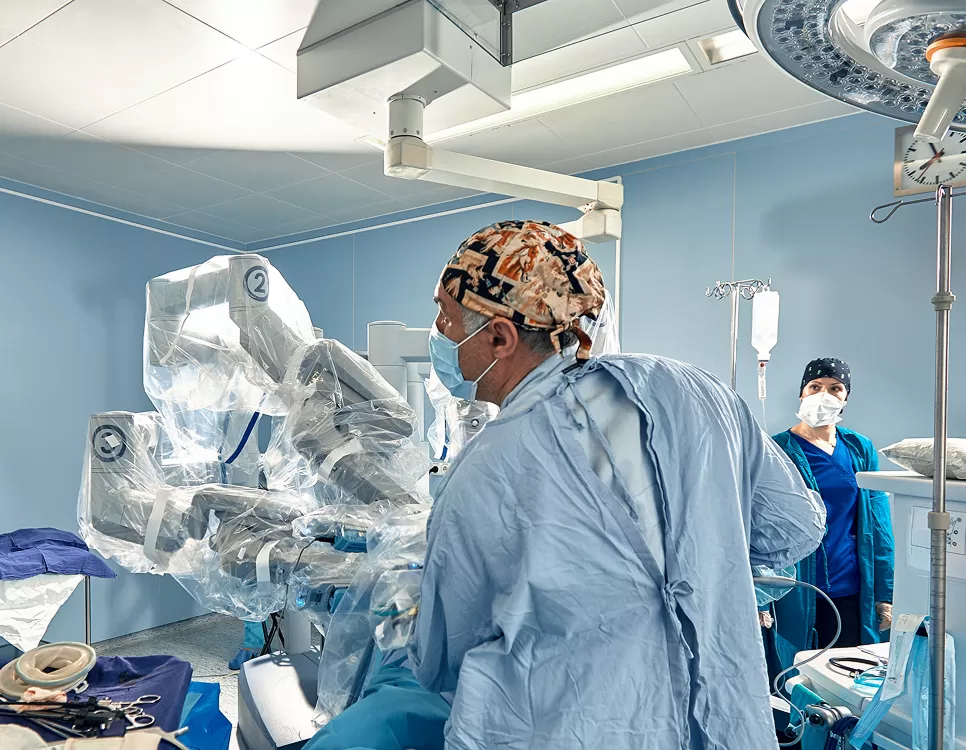
Robotic knee surgery uses advanced computer-assisted technology to help surgeons position joint implants with greater accuracy than traditional manual methods.
Living with severe knee pain changes your life. It is not just about sore joints. It is about missing out on morning walks, struggling with stairs, or hesitating to play with your grandchildren.
Surgical technology has advanced significantly in recent years. Robotic-assisted knee surgery represents one of the most substantial shifts in how we approach joint replacement. It allows us to move away from a “one size fits all” philosophy toward a truly personalised treatment.
This guide explains exactly what robotic knee surgery involves and how it differs from traditional methods. It will help you understand if this approach is right for your situation.
There is a common misconception that a robot performs the surgery. This is not the case.
I remain in complete control throughout the entire procedure. The robotic platform is simply an advanced tool. It assists me in achieving optimal implant positioning with a level of accuracy that is difficult to replicate with the human eye alone.
We typically use systems like the MAKO robotic platform. This technology uses sophisticated software to turn a CT scan of your knee into a three-dimensional virtual model.
During the operation, the system provides real-time guidance. It uses haptic feedback, which is a physical resistance you cannot see but I can feel through the instruments. This helps ensure I position the implant components exactly according to the plan we created before you entered the operating theatre.
Published research shows that robotic-assisted systems can achieve alignment accuracy within 0.5-1mm. Traditional freehand techniques typically see a variation of 2-3mm.
This precision matters. Accurate alignment can lead to better soft tissue balance and may help your new knee last longer.
Traditional knee replacement relies on mechanical alignment guides and the surgeon’s visual assessment. Experienced surgeons achieve excellent results with these conventional techniques. However, manual measurements always carry a small degree of variability.
Robotic-assisted surgery enhances the traditional approach in five specific ways.
Surgical expertise remains the most critical factor. Robotic technology enhances precision, but a successful outcome depends on the surgeon’s skill and judgement.
The main advantage of robotic assistance is the ability to align the implant precisely. Research suggests that when components are aligned correctly, it reduces wear on the implant and improves knee stability.
Studies indicate that robotic techniques achieve this optimal alignment more consistently than conventional methods. For you, this precision could mean your knee replacement lasts longer. Current data suggests precise alignment may help implants approach or exceed the typical 15-20 year lifespan of traditional replacements.
Traditional mechanical alignment often treats every knee the same. It aims to create a straight line from the hip to the ankle.
Robotic surgery allows for personalised alignment. We use the 3D model from your CT scan to plan the implant position based on your specific anatomy. We do not have to force your knee into a standardised template.
Evidence suggests that this personalised approach may improve patient satisfaction. It helps the new knee feel more natural and function better for your specific body.
The robotic system helps us preserve the healthy tissue surrounding your knee joint.
Because the bone preparation is so precise, we can minimise excess bone removal. The system’s haptic feedback prevents instruments from straying beyond the necessary area. This reduces trauma to the surrounding muscles and ligaments.
Every patient heals differently. Your recovery will depend on your age, health, and commitment to physio. However, research indicates that robotic-assisted surgery may offer recovery benefits for some patients.
The process begins well before the day of your operation.
About 1-2 weeks before surgery, you will have a CT scan of your knee. This takes about 15-20 minutes and is painless. This scan generates the 3D model of your anatomy.
I use specialised software to analyse this model. I can measure your unique alignment and select the optimal implant size. I can even simulate the surgery virtually to see how different positions will affect your knee’s stability.
This means I enter the operating theatre with a clear plan tailored specifically to you.
On the day of surgery, you will be under anaesthesia. The procedure typically takes 60 to 90 minutes, which is similar to traditional surgery.
We start by registering your anatomy. We calibrate the robot to match your actual knee with the 3D model from your CT scan.
Once verified, I use the robotic arm to prepare the bone. The haptic feedback guides my hand, ensuring I only remove the bone necessary to fit the implant. We can also make real-time adjustments if the tissue tension feels different than expected.
Finally, we position the implant and assess the knee’s stability and range of motion before closing.
Recovery is a journey. While robotic surgery adds precision, your commitment to rehabilitation is what restores function.
The focus here is on wound healing and managing pain. You will likely stay in the hospital for 1-2 days. You will start walking immediately, usually with a walker or crutches.
Most patients recover well at home. We provide clear instructions on wound care and pain relief.
Rehabilitation intensifies during this phase. You will likely have physiotherapy 2-3 times a week.
The goal is to improve your range of motion. We aim for 0-110 degrees of flexion. You will transition from walking aids to walking independently. Many patients resume light activities like short walks during this time.
By this stage, most patients see significant improvement. You can usually return to normal daily activities like household tasks and light gardening.
Driving often resumes around 6-8 weeks, provided you are off strong pain medication and have regained adequate control of your leg.
Most patients have returned to their desired lifestyle activities by this point. You can engage in low-impact sports like golf, swimming, or cycling.
Remember that final recovery takes time. It can take up to a year for the knee to feel completely settled.
Robotic-assisted surgery is an excellent option for many patients, but it is not the only way to treat knee arthritis.
This technology may be appropriate if you:
There are situations where traditional surgery might be preferable or necessary.
During your consultation, I will review your imaging and medical history to determine the best approach for you.
It is important to have an honest conversation about risks. Knee replacement is generally safe, but complications can occur with any surgery.
Uncommon Risks (<1-2%)
Less Common Risks (2-5%)
Published research suggests robotic-assisted surgery may reduce some complication rates due to better alignment and less soft tissue trauma. However, your individual risk depends on your general health and medical history. We will discuss your specific risk profile in detail during your appointment.
I am a knee subspecialist with dual fellowship training. I hold fellowships from both the Royal College of Surgeons, England (FRCS) and the Royal Australasian College of Surgeons (FRACS).
My practice focuses exclusively on knee conditions. This specialisation allows me to maintain deep expertise in complex cases and advanced techniques like robotic surgery.
I believe in a personalised approach. I will evaluate your specific condition and discuss all treatment options, including non-surgical ones. I only recommend robotic assistance when the clinical assessment shows a genuine benefit for your individual case.
I provide robotic knee replacement surgery across South West Sydney and the Mid North Coast. This ensures regional patients can access advanced technology without travelling to the city centre.
South West Sydney
Mid North Coast
If knee pain is affecting your daily life, the first step is a comprehensive assessment.
During your initial consultation, we will review your X-rays or MRI scans. We will discuss your symptoms and your goals for recovery. I will answer your questions about the robotic procedure and help you decide if it is the right path for you.
You do not have to live with severe knee pain. There are effective, precise options available to help you get moving again.
To book your consultation